Your brain after loss
Apr 27, 2026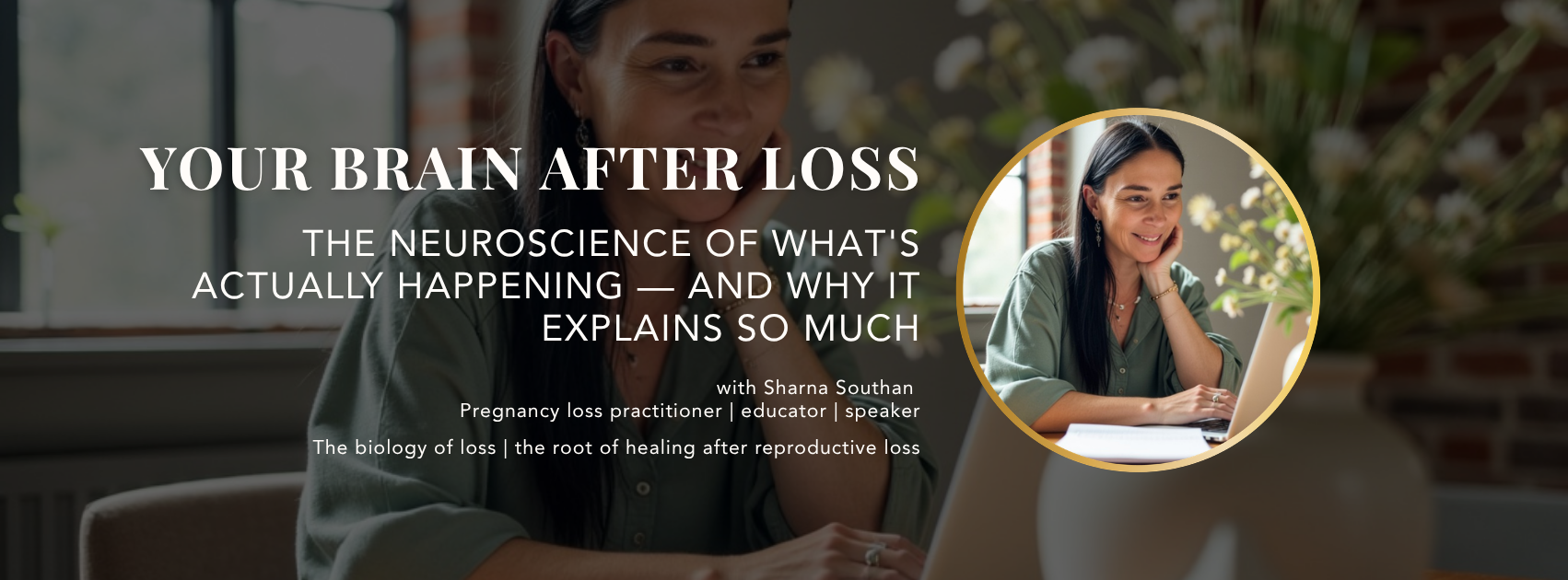
The neuroscience of what's actually happening — and why it explains so much
There is a moment many women describe after pregnancy loss where they look around at their life and think: what is wrong with me?
- They can't concentrate.
- They forget simple things.
- They feel numb one hour and completely overwhelmed the next.
- They startle easily.
- They avoid certain places, certain songs, certain dates on the calendar.
- They feel like they are watching their life from the outside.
Nothing feels wrong enough to explain it. And nothing feels right enough to move on.
If that is you, or has been you, I want you to understand something important: there is nothing wrong with you. There is something happening in you. And it has a neurological explanation.
Your brain's one job
Before we talk about what changes after loss, it helps to understand what the brain is always doing.
The brain's primary job, above all else, is to keep you alive. Every function, every response, every system is organised around survival. And the part of the brain most responsible for that job is the limbic system, particularly the amygdala, which acts as your brain's threat detection centre.
The amygdala is fast, automatic, and doesn't distinguish between physical danger and emotional overwhelm. When it detects a threat, real or perceived, it activates the stress response. Cortisol and adrenaline flood the system. The body prepares to fight, flee, or freeze.
This is not a malfunction. This is brilliant, intelligent design.
The problem arises when the threat doesn't pass. When the nervous system stays activated. When the amygdala keeps firing because the loss hasn't been fully processed, and the brain remains on high alert long after the event itself is over.
What happens to the brain after pregnancy loss
The amygdala becomes hyperactive. After trauma, the amygdala can become sensitised — more reactive, more easily triggered. This is why certain smells, sounds, dates, or situations can send you straight back into the acute experience of loss without warning. Your brain isn't being dramatic. It has been conditioned to treat those cues as potential threats and respond accordingly.
The prefrontal cortex goes offline. The prefrontal cortex is responsible for rational thinking, decision making, emotional regulation, and perspective. Under stress, blood flow is redirected away from the prefrontal cortex toward the survival centres of the brain. This is why, in the acute aftermath of loss, it can feel impossible to think clearly, make decisions, or see any way forward. Your brain has literally deprioritised those functions in favour of survival.
The hippocampus is disrupted. The hippocampus plays a critical role in memory consolidation and in giving memories a sense of time, of past versus present. Trauma disrupts this process. This is why traumatic memories can feel present tense rather than past tense. Why the body can respond to a trigger as though the loss is happening now, not then. The brain hasn't filed it safely in the past yet.
The nervous system stays dysregulated. Through the HPA axis, the communication system between the brain and the adrenal glands, chronic stress keeps cortisol elevated. Over time, this affects sleep, immunity, digestion, hormonal balance, and energy. The body is not separate from any of this. It is running the same program as the brain.
What this looks like in real life
This neuroscience isn't just theory. . It shows up in the everyday experience of life after loss:
- Feeling fine and then completely undone by something small
- Difficulty remembering things or concentrating at work
- Avoiding pregnancy announcements, baby showers, or certain social media accounts
- Feeling disconnected from your body or your life
- Sleep that doesn't restore you
- A sense of constant low-level anxiety even when nothing is actively wrong
- Physical symptoms, gut issues, tension, fatigue, immune disruption, that seem unrelated but aren't
None of this is weakness. None of this is you failing to cope. This is a nervous system that has been through something genuinely overwhelming doing exactly what it was designed to do.
Why this changes everything about healing
When we understand that pregnancy loss has a neurological impact, not just an emotional one, it changes what healing needs to look like.
Talking about your feelings is important. But it is not enough on its own to regulate a dysregulated nervous system. It is not enough to calm an overactive amygdala. It is not enough to restore the prefrontal cortex's capacity for perspective and regulation.
Healing after pregnancy loss needs to include the brain and the body — not just the story of what happened.
This is why I built the Pregnancy Loss Recovery Method™ around neuroscience. Not to make it clinical or complicated, but because women deserve support that actually matches what is happening inside them.
You are not stuck because you are weak. You may be stuck because the support you've received hasn't reached the level where the work actually needs to happen.
For the woman reading this
The next time you wonder what is wrong with you, I want you to remember this:
Your brain is doing exactly what a brain does after overwhelming loss. It adapted to protect you. And now it needs support to learn that you are safe, that the threat has passed, and that it can begin to reorganise around a new normal.
That is not a quick fix. But it is absolutely possible.
And it starts with understanding what is actually happening.
Next in the series: Why You Don't Feel Like Yourself Anymore — the identity disruption of pregnancy loss that nobody talks about.
About Sharna
Sharna Southan is a Reproductive Trauma Neuroscience Specialist and founder of the International Institute for Reproductive Loss & Trauma Leadership — creator of the world's first neuroscience-informed framework for pregnancy loss recovery. Training practitioners globally. Supporting women through specialist care. Hosting the top-ranked podcast What I Wish I Knew After Pregnancy Loss.
This is where the standard is being built.