What does "Recovered" mean after pregnancy loss?
Nov 09, 2026
Atara Parkinson had been in labour for 32 hours, with third-degree tears and more stitches than she could count, and her first baby was in the NICU. She was being discharged to family housing a few blocks from the hospital. As her husband wheeled her toward the door, a security guard stopped them, because the wheelchair couldn't leave hospital grounds. She would have to walk.
Atara is a licensed marriage and family therapist, and she shared that moment with me on my podcast. Ten years on, she still sees it as the moment she understood how our culture treats mothers: once the baby is out, the mother disappears.
For women leaving hospital after pregnancy loss, there often isn't even a wheelchair. She gets her discharge paperwork with a line about keeping an eye on her mental health, and then she goes home. At some point, someone will tell her she's recovered.
What "recovered" means on paper
Medically, recovery after pregnancy loss is usually measured by a handful of markers: the bleeding has stopped, hormone levels are back to baseline, there's no sign of infection and she's been told when it's safe to try again.
Those markers matter, and what they measure is the end of the medical event. The woman who's been cleared can still be lying awake replaying the words "there is no heartbeat", or bracing every time she sees a pregnancy announcement. Her body can be signed off while it still feels like a place that isn't safe.
What women told me was missing
Since 2019 I've been asking women what they needed after pregnancy loss, and what they actually got. Across four surveys I've gathered 106 responses from women in seven countries. These are small groups, mostly reached through online support communities, so read them as lived experience that sits alongside the published research. Across seven years and four different sets of questions, the answers keep landing in the same place.
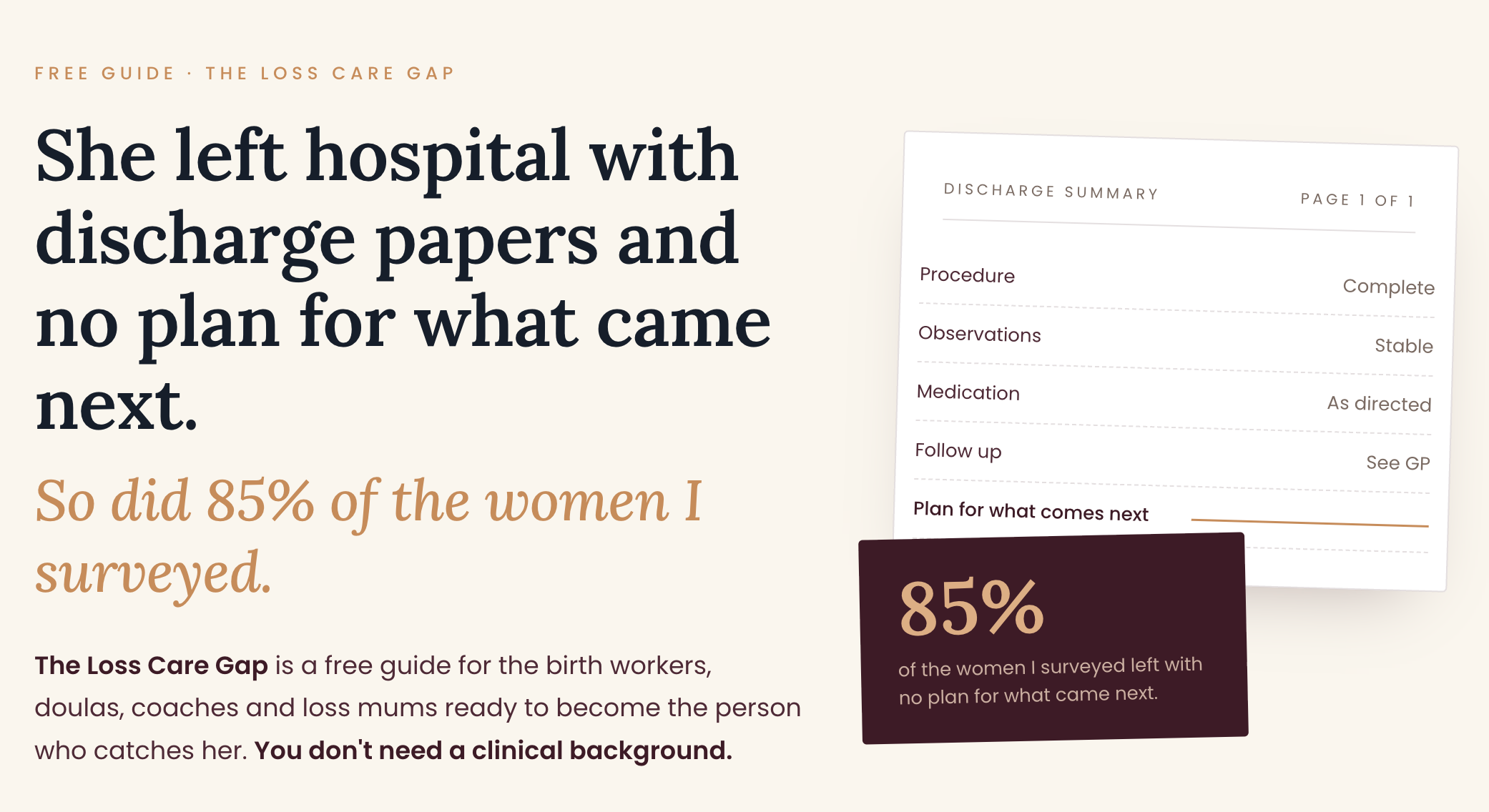
Most women were never referred anywhere. Of the women I asked about referral, 77% were never referred to any support after their loss, not even a counsellor or a support group. In 2019 it was nearly 4 in 5, and this year it was 6 of 9.
Her body was never explained. In my first survey, 25 of the first 30 women received little or no information about what would happen to them. Nobody told them they might go into labour or bleed for weeks, and nobody mentioned they might see their baby. This year, women rated the care for their physical recovery 1.9 out of 5.
Her nervous system was left on its own. This year I asked about it directly, and 8 of 9 women gave the care for their emotions and nervous system the lowest score possible, 1 out of 5. It's the strongest finding across all four surveys.
Seven years apart, care still stops in the same place: when the medical part is over.
Why she doesn't feel recovered
I know this gap from the inside. After my own loss I was sent home with the instruction so many women get, to keep an eye on my mental health. Nobody told me I was also postpartum, or that my body was going through anything beyond grief. So I kept an eye on it, and I still slid back toward the depression I'd lived through years earlier. My husband saw it before I did.
When I eventually saw a psychologist, she named what had happened as trauma. That was a huge relief, though it didn't tell me what to do with it.
Over the next couple of years my physical health declined, and I bounced between fight or flight and shutdown. My heart would race and I'd want to run, then I'd freeze. I was sighing constantly and breathing shallow, always trying to catch my breath. My mum once told me I looked like I was protecting my heart. My shoulders had curled in, and standing up straight hurt. Five years of talk therapy hadn't reached any of that.
As Atara put it on the podcast, there's no line across our neck that separates the body from our mental health.
Research shows the communication between body and brain runs both ways, and mostly upward: around 80% of the fibres in the vagus nerve carry information from the body to the brain (Breit et al., 2018).
In practice, we often see what that looks like after loss: sleep that won't come because the mind keeps replaying the day, breath that stays high and shallow, a body that tenses at a negative pregnancy test, and fear that arrives with the next positive one. When nobody explains what's happening in her body, she tends to file it away as threat.
That's how "recovered" can be true on paper and false in her body at the same time.
What "recovered" could mean instead
If recovery only means the medical markers have cleared, the bar sits exactly where care ends. When I asked women what they wanted to feel, they told me: peace, hope, heard, safe to try again, like themselves again. So recovery could mean:
- Her body is understood. Someone explains what happened and what to expect next, in plain words.
- Her nervous system is supported back to safety, with the way she sleeps and breathes treated as part of her recovery.
- Her grief is held by someone who understands this loss. Most women I surveyed wanted to know whether the person supporting them had been through loss themselves.
- She feels safe facing what comes next, including the next pregnancy if that's her path.
- Her baby is honoured. One woman told me she was unsure about support because she was afraid that if the pain went, the memory of her pregnancy would go with it. Recovery means she can carry her baby with her without being flattened by the loss.
None of this has to happen all at once. Atara's advice on the podcast was to start with one thing that feels manageable, like a nourishing breakfast or one safe person to talk to. Small, steady steps are how a body learns it's safe again.
She's already in your room
The place where care let her down is the place she wants to be found. When I asked women where they wanted to hear about support, they named their OB or midwife first, followed by their GP and the hospital. She wants support offered in the room where she hears the news, before she has to go searching for it weeks later.
She's also far more open to it than we assume. When I described specialist support clearly to 40 women in 2019, the number leaning toward yes went from 23 to 32, which is 4 in 5. The only thing that changed in that minute was how clearly the support was explained.
Women want help, and what's missing is the bridge between the medical event and everything that comes after it. If you're a midwife, GP, doula, counsellor or coach, you've almost certainly met her already, maybe months later when she finally said it out loud.
Years ago I decided to train the people she already trusts. Practitioners I've trained now support women in the USA, the UK, Croatia and Australia.
Join me on 12 November
On Thursday 12 November, inside the Reproductive Loss Leaders Room, I'm running What Was Missing?, a live training on all seven threads of missing care drawn from seven years of women's own words. We'll look at where she wants to be found and what you can do to close the gap where you work.
The training is included in Room membership ($89 USD a month).
Join the Room for What Was Missing? https://www.sharnasouthan.com/leaders-room-membership
Listen to the conversation
Hear Atara's full story and our conversation about the body, the brain and the gap after hospital in Episode 142 of What I Wish I Knew After Pregnancy Loss: When the system sends you home and calls it care.
Listen to EP142: https://www.sharnasouthan.com/podcasts/what-i-wish-i-knew-beyond-pregnancy-loss/episodes/2149240359
You can find Atara on Instagram at @atara.parkinson, at @nicuheartscollective and at www.ataraparkinson.com.
Sources
- Southan, S. Pregnancy loss surveys, 2019 (two surveys, 70 responses), 2020 (27 responses) and 2026 (9 responses). The 77% referral figure comes from the three surveys that asked about referral. The 2026 survey used trauma-informed language in its questions. Lived-experience data, not a census.
- Breit, S., Kupferberg, A., Rogler, G. and Hasler, G. (2018). Vagus nerve as modulator of the brain, gut axis in psychiatric and inflammatory disorders. Frontiers in Psychiatry, 9, 44.
- Parkinson, A. and Southan, S. EP142, What I Wish I Knew After Pregnancy Loss podcast.
Sharna Southan is the founder of The International Institute of Reproductive Loss Leadership, creator of the Pregnancy Loss Recovery Method™, and host of What I Wish I Knew After Pregnancy Loss.