The Niche With 23 Million Women in It | Pregnancy Loss
Oct 27, 2026
Someone told me recently that my work is very niche.
They're right. I work in pregnancy loss and I've never stepped outside it. After that conversation I went back to the global numbers, because I wanted to see the size of this niche properly.
Every year, worldwide:
- About 23 million pregnancies end in miscarriage. That's 15.3% of recognised pregnancies. It also leaves out the very early losses that get written off as a late period.
- 3.04 million babies are stillborn from 20 weeks. Close to a million of them (0.926 million) die between 20 and 28 weeks, so any count that starts at 28 weeks leaves them out.
- There are 8.38 million ectopic pregnancies. Detection and reporting vary widely between countries, so the real figure could be higher.
- Molar pregnancy has no global count. In Norway's national registry, molar pregnancies made up about 0.1% of recorded pregnancy outcomes, 823 of them between 2008 and 2018.
- Termination for medical reasons has no global count either. Across 12 European countries, 3.4 in every 1,000 births ended in termination for a fetal anomaly before 24 weeks. Everywhere else, these women are folded into general abortion statistics and never counted as a loss at all.
These figures count pregnancies rather than women, so they can't be added together. Some women appear in them more than once, because they've lost more than one pregnancy. Each pregnancy still had a woman inside it, and very often a partner beside her, and most of them went home and tried to carry on with their week.
So the niche is narrow, and the number of women in it is enormous.
What happens to her after the loss
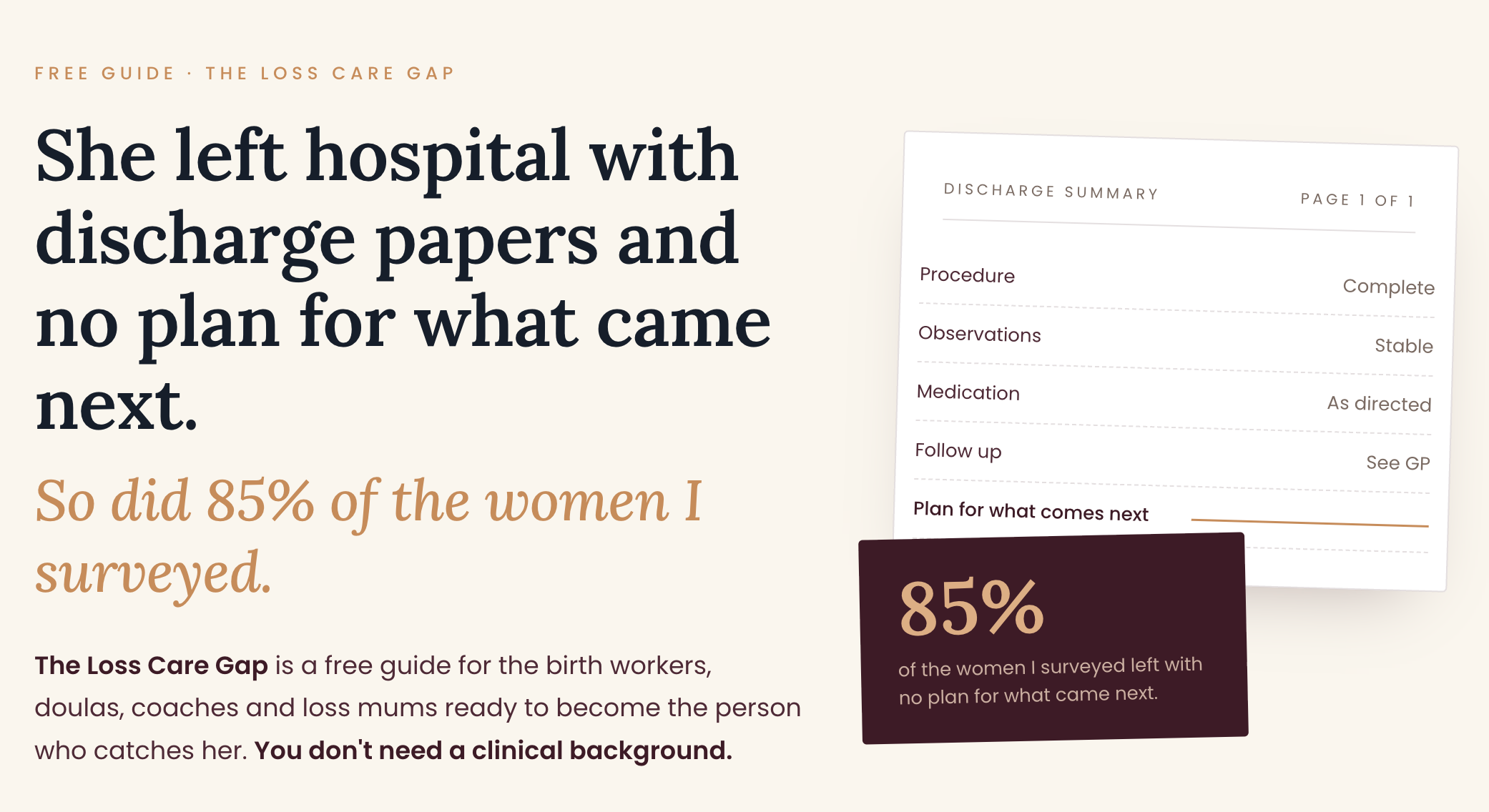
In 2019 I surveyed 40 women across six countries who had been through pregnancy loss. 85% of them got no professional referral to support afterwards.
I've since mapped seven places where a woman falls through care after a loss, and I call that map the Loss Care Continuum. Almost straight away she reaches the second one: her mental health. Maternity care steps back because there's no longer a pregnancy to look after, and grief services often don't count an early loss as a bereavement. Her mental health ends up claimed by neither, and she walks out with discharge paperwork and nobody whose job it is to check on her.
From there the gaps carry on, through a postpartum nobody names, a nervous system still braced months later, and every scan in the next pregnancy. At each point a professional looks after one piece of her, and nobody holds the whole line.
That's what a specialist field looks like. The size of a niche comes from how many people need it, and millions of women a year need it.
The people already holding space for her
This week I followed a woman who runs creative writing for bereaved parents. Her work gives grief somewhere to go when it has no words yet. Reading about it, I kept thinking about how many people are already doing this work quietly, outside any official care pathway. They run circles, writing groups and peer support spaces. Some are doulas or counsellors, and some came into this field after a loss of their own.
If that's you, you'll know the moment in a circle when someone starts to say more than the story of the loss. Maybe she can't sleep. Maybe she flinches every time a friend announces a pregnancy, or she's terrified to try again. Those moments go deeper than anyone usually takes the conversation after pregnancy loss, and they're exactly where she needs someone who knows where to take it next.
You can only support someone as far as your own knowledge reaches, and none of us can see the gaps we haven't been shown yet. Research on reproductive loss keeps moving, and the practitioners who keep learning alongside it are the ones women end up trusting most.
The Reproductive Loss Leaders Room is where you bring the client you're carrying, find the right person to refer her to, and get back to your week.
Inside, there's a referral library so you always know who to hand her to next. Every fortnight there's a live call where you can bring the woman you're worried about and talk it through with people who understand. There are also guest sessions on replay and the full Gap series library. Every conversation in the Room is about pregnancy loss, so you never have to explain why your work matters.
You'll learn things in there, and you'll also be seen in your work by people doing the same work.
If you want to see where women fall through first, start with the free guide: Download The Loss Care Gap → sharnasouthan.com/the-loss-care-gap
If you're ready to stop holding her on your own: Join the Reproductive Loss Leaders Room → sharnasouthan.com/leaders-room-membership
Sharna x
Sources
- Miscarriage: Quenby et al., The Lancet (2021)
- Stillbirth and ectopic pregnancy: Global Burden of Disease Study 2021 analyses (stillbirth 95% UI 2.61-3.62 million; ectopic 95% UI 6.65-10.42 million)
- Termination for fetal anomaly: population-based registry study across 12 European countries, 2000, 2005
- Molar pregnancy: Norwegian registry study of linked pregnancy outcomes, 2008-2018
- Survey: Sharna Southan, 2019 survey of 40 women across six countries