Why every practitioner doesn't need to do the same thing in Pregnancy Loss care
Jul 21, 2026
If you've ever sat in a training, a masterclass, or a certification program and thought — this doesn't quite fit what I do — I want you to know that reaction isn't a problem to solve.
It's information.
Pregnancy loss care has a positioning problem.
Not a passion problem — the women stepping into this space are some of the most devoted practitioners I've ever met.
The problem is that we've inherited a model that assumes support for bereaved mothers looks one way: one modality, one type of practitioner, one point of contact.
It doesn't. It never has. And the sooner we let go of that assumption, the sooner bereaved mothers actually get the care they need.
There isn't one way to support bereaved mothers
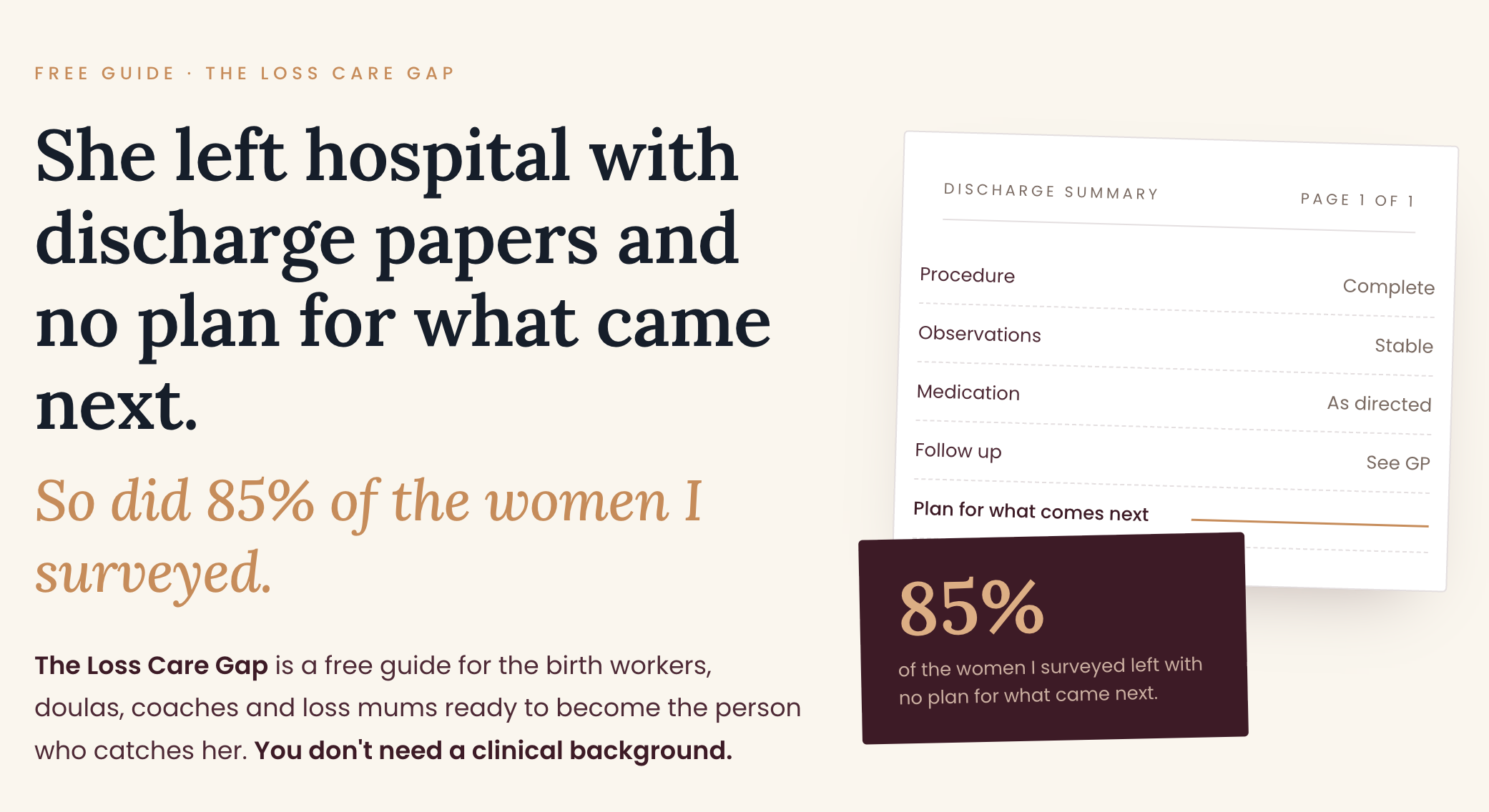
Right now, 78% of women who experience pregnancy loss receive no referral to specialised support at all. (a survey I conducted with bereaved mothers)
Not because the support doesn't exist somewhere — but because the system that's supposed to connect her to it is built around a single, narrow pathway.
If she doesn't land in exactly the right door, she's told there's nothing more to offer her.
But grief after loss isn't one-dimensional, so why would support be?
A woman might need somewhere to process what happened to her body.
Somewhere to rebuild trust in it before trying again.
Somewhere to talk about the identity rupture that no one warned her about.
Somewhere to be witnessed without being rushed toward "moving on."
Somewhere to make sense of a loss that happened years ago and was never acknowledged as a loss at all.
That's not one somewhere. That's many.
Every profession has a role
This is the part I want practitioners to really sit with: you do not need to specialise in pregnancy loss to encounter it.
Birth workers, doulas, and midwives — she will be in your care during a subsequent pregnancy, carrying fear your training may not have named.
Fertility coaches and IVF support practitioners — she may be sitting across from you mid-treatment, still holding a loss no one asked about.
Postnatal and perinatal mental health practitioners — she may be presenting with anxiety or depression that has roots in a loss that was never actually processed.
Pelvic floor physios, lactation consultants, general grief counsellors, and menopause coaches — she may be carrying a loss from decades ago that has never once been named in any room she's been in.
None of you need to become "the pregnancy loss person" to matter here.
You already have a role. The work is recognising it — and knowing what to do with it when she shows up, because she will.
We need integrated care
What bereaved mothers actually need isn't a single perfect specialist. It's a web of practitioners across different disciplines who each understand their specific piece of the picture, and who know how to hold it without causing harm.
This is the difference between peer support and professional support. Peer support opens the door to someone's story, sits with them in it, and says "I've been there too." That matters — but on its own, it can leave the door open without a way through. Professional support does the same opening, but pairs it with a framework: a way to help her process, integrate, and move forward, rather than simply revisiting the same pain on repeat.
Integrated care means she doesn't have to hope she lands in the one right room. It means whichever room she walks into — a birth class, a fertility clinic, a therapy session, a nutrition consult — the practitioner in it knows enough to recognise what's underneath, and either hold it well or refer her onward with care.
That only works if practitioners across every discipline are equipped — not identically, but specifically, in the area where they already sit.
How do I find my role in integrated pregnancy loss care?
You start with your own story, not a generic curriculum.
The specific loss, or losses, or gap you've lived through or witnessed points to the exact role you're positioned to play — whether that's building something new or recognising how this work already folds into the practice you've spent years building.
This is exactly why I built Loss to Legacy as a four-week immersion, not a one-size-fits-all training.
It doesn't start by teaching you a single modality and asking you to apply it universally.
It starts with your story and builds from there to your purpose, your unique positioning, and the precise role you're here to play in this broader, integrated picture of care.
For some women, that means building something entirely new. For others, it means finally understanding how this work fits into the practice they've built over the years.
Either way, the goal isn't to make you into a version of me, or a version of any other practitioner in this space. It's to help you get specific enough about your own story that you stop trying to be everything to everyone — and start becoming exactly what the women who need you are looking for.
Because the truth is simple: bereaved mothers don't need more practitioners doing the same thing.
They need practitioners who know exactly what their thing is.
Loss to Legacy, my four-week immersion, opens for a new intake on August 4th. Five spots.
If this article named something in you, DM me the word LEGACY and let's talk about the role you're here to play.
DM me here to apply today: @reproductivelossleadership